


 Cart
Cart
 sales@molnova.com


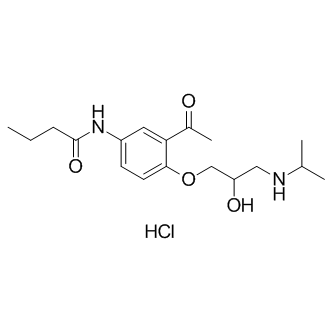
Acebutolol hydrochloride
CAS No. 34381-68-5
Acebutolol hydrochloride( —— )
Catalog No. M14173 CAS No. 34381-68-5
A cardioselective beta blocker for the treatment of hypertension and arrhythmias.
Purity : >98% (HPLC)
 COA
Datasheet
HNMR
HPLC
MSDS
Handing Instructions
COA
Datasheet
HNMR
HPLC
MSDS
Handing Instructions
| Size | Price / USD | Stock | Quantity |
| 50MG | 38 | In Stock |


|
| 100MG | 43 | In Stock |
|
| 200MG | 55 | In Stock |
|
| 500MG | Get Quote | In Stock |
|
| 1G | Get Quote | In Stock |
|
Biological Information
-
Product NameAcebutolol hydrochloride
-
NoteResearch use only, not for human use.
-
Brief DescriptionA cardioselective beta blocker for the treatment of hypertension and arrhythmias.
-
DescriptionA cardioselective beta blocker for the treatment of hypertension and arrhythmias.Hypertension Approved(In Vivo):Acebutolol is a beta blocker for the treatment of hypertension and arrhythmias. Acebutolol following single intravenous administration (10 mg/kg) to rat results in the plasma clearance of 61.9 mL/min/kg, the volume of distribution of 9.6 L/kg, and an elimination half-life of 1.8 hours. Acebutolol following single intravenous administration (50 mg/kg) to rat results in the plasma clearance of 46.5 mL/min/kg, the volume of distribution of 9.5 L/kg, and an elimination half-life of 2.3 hours.Acebutolol (30 mg/kg) decreases cardiac output by 65% and 31% after 1 min and 10 min measurements, respectively, in Sprague-Dawley rats. Acebutolol (30 mg/kg) significantly reduces regional blood flow (RBF) in most organs either after 1 min or 10 min measurements when compare with the baseline values in Sprague-Dawley rats.
-
In Vitro——
-
In VivoAcebutolol is a beta blocker for the treatment of hypertension and arrhythmias. Acebutolol following single intravenous administration (10 mg/kg) to rat results in the plasma clearance of 61.9 mL/min/kg, the volume of distribution of 9.6 L/kg, and an elimination half-life of 1.8 hours. Acebutolol following single intravenous administration (50 mg/kg) to rat results in the plasma clearance of 46.5 mL/min/kg, the volume of distribution of 9.5 L/kg, and an elimination half-life of 2.3 hours.Acebutolol (30 mg/kg) decreases cardiac output by 65% and 31% after 1 min and 10 min measurements, respectively, in Sprague-Dawley rats. Acebutolol (30 mg/kg) significantly reduces regional blood flow (RBF) in most organs either after 1 min or 10 min measurements when compare with the baseline values in Sprague-Dawley rats.
-
Synonyms——
-
PathwayGPCR/G Protein
-
TargetAdrenergic Receptor
-
Recptorβ-adrenergicreceptor
-
Research AreaCardiovascular Disease
-
IndicationHypertension
Chemical Information
-
CAS Number34381-68-5
-
Formula Weight372.8869
-
Molecular FormulaC18H29ClN2O4
-
Purity>98% (HPLC)
-
Solubility10 mM in DMSO
-
SMILESN1(CCCCC1)CCCNc1ccc(c2CCCCc12)\N=N\c1cnc(cc1)OC
-
Chemical NameButanamide, N-[3-acetyl-4-[2-hydroxy-3-[(1-methylethyl)amino]propoxy]phenyl]-,hydrochloride (1:1)
Shipping & Storage Information
-
Storage(-20℃)
-
ShippingWith Ice Pack
-
Stability≥ 2 years
Reference
molnova catalog



related products
-
LY377604
LY377604 is a human β3-adrenergic receptor agonist (EC50: 2.4 nM) and β1/2-adrenergic receptor antagonist for the study of obesity.
-
L748337
L748337 is a competitive and potent β3-adrenoceptor antagonist that inhibits the action of β3-, β2-, and β1-adrenoceptors, activates MAPK signaling, promotes phosphorylation of Erk1/2, and inhibits the protective effects of CL316243, and is used in the study of disorders caused by abnormalities of the β3-adrenoceptors.
-
Fenoterol hydrobromi...
Fenoterol hydrobromide is an orally active and selective β2-adrenoceptor agonist and bronchodilator used in the study of cardiovascular diseases such as asthma and bronchitis.
